Interview Interview with Ms. Deborah Weaver
Hello everyone, my name is Neil Dutta, a Sharon High School Student.
I got the opportunity to interview Ms. Deborah Weaver on August 15th, 2026 at the Westford River Watershed Alliance, on behalf of Volunteering for Seniors, VFS (based in Easton, MA).

I am grateful to Ms. Deborah Weaver for sharing her remarkable journey as a teacher, community leader, environmentalist, and lifelong advocate for her community. From growing up in New Haven, where she learned as a child that ordinary people could organize to protect the environment, to building a career spanning the performing arts, martial arts, nonprofit leadership, and conservation, Ms. Weaver’s life has been shaped by resilience, resourcefulness, and a commitment to making a difference.
Throughout our conversation, Ms. Weaver emphasized that meaningful change begins with engagement. Her work at the Westport River Watershed Alliance reflects this philosophy: she transformed the organization into a welcoming community resource through river tours, educational programs, cleanups, and partnerships that allowed people to experience and appreciate the natural world firsthand. She also spoke candidly about the challenges of leadership, particularly the patience required to navigate resistance and uncertainty while pursuing a larger vision.
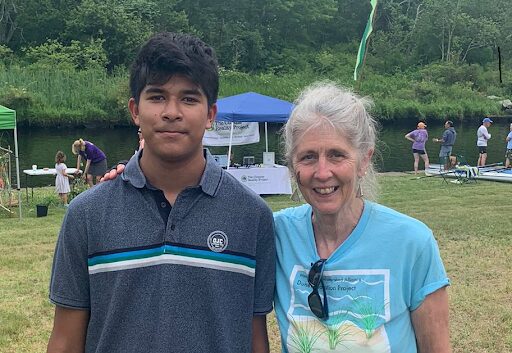
One personal detail that stood out to me in the interview was how closely Ms. Weaver’s love for the environment continues to shape her everyday life. Even in retirement, she is involved in river tours, spending time biking, kayaking, hiking, and appreciating the natural beauty she has spent her career protecting. Through her efforts, in the last four-years. I got to learn and respect first-hand Indigenous culture and traditions which protected this land for millennia before European colonization.
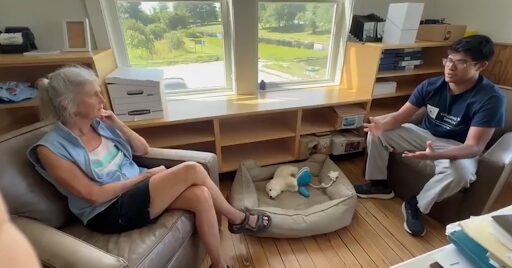
At the very beginning, Ms. Weaver welcomed me in her office at the River Center, she introduced me with her dog and as we settled, I started with my first question, which Ms. Weaver responded very patiently as I have asked almost multiple questions about her childhood within my introductory question.
1. Could you tell me more about your childhood, where you grew up, more about your family and education, and maybe any experiences that shaped you today?
Ms. Deborah Weaver: “I grew up in New Haven, Connecticut, and I ended up going to college in London, England. I went there at 16 years old because I left high school a year early. I was in the performing arts field, so I was very interested in going to a place that would teach me a lot about performing arts.
I was the middle of five children, and I think probably I wanted to get away from my family and have a really different kind of experience. But I didn’t have any clue what I was getting into going to London. I didn’t realize that colleges in England, they don’t feed you, they don’t house you. It’s almost like a trade school.
And so I would say that was probably a very intense education in self-sufficiency because I had to get a job, had to find a place to live, and go to college full-time for three years. So it taught me a lot about being resilient and resourceful and figuring out what I actually needed. So I think those were all things that shaped my future in a lot of ways.
I came back to the States and started teaching dance and working in the community to help children express themselves through dance and theater. In fact, I think I did a residency in Sharon at one point. I did a lot of Artists in Residence around New England.
So my first career was really in the performing arts, and then my second career was in martial arts. Then I ended up here in Westport and was asked to apply for the job at the Watershed Alliance. Very different kind of work, but because I had formed two different nonprofits in Boston, I had a lot of nonprofit experience, which they needed”.
2. When did you first develop a connection with the environment and conservation?
Ms. Deborah Weaver: “You know, my very first experience of political activism, I was a child, and my father led a group in New Haven that was trying to prevent a highway from going through the park across the street from where we lived. And he called the group Save the Park.
He trained us kids, my family and other kids, to lead tours of this park, which had a river running through it and a swamp. And we would take adults on these tours to show them that even though the park itself was kind of beat, and the equipment was terrible and everything, if you went down the hill, there was a whole river environment, and that was just magical. We saw beavers there and all kinds of birds.
And so we actually prevented the highway from going through it. And I think that was the first time in my life – I must have been only about seven or eight, that I realized that you could organize around an important environmental issue and actually make a difference.
And if you’re driving south from Hartford, there’s an off-ramp that stops. And I always look at it and say, Oh, that’s the off-ramp that would have gone through our park. So that was my start in the environmental world.”
3. What brought you to the Westport River Watershed Alliance?
Ms. Deborah Weaver: “Well, there were really two or three things. First of all, I had founded and ran a nonprofit in Boston that was just very intense, very, very urban, really working in very impoverished communities, and I was pretty exhausted. I wanted to live a quieter life, and I had friends down here in Westport, and so I moved down here.
My husband was actually working for the Department of Environmental Protection in Boston, and I thought, okay, I’m going to retire and have this quiet life and live by the river, and it’s all going to be lovely. And then, after about a year, I started to get kind of restless and thought, “I’m awfully young to be retired.”
And the Watershed Alliance invited me to apply for the job. I didn’t have a science background, but at the time they really needed somebody who knew how to run a nonprofit, which I did know. And they had purchased this building but had no real articulated vision for what it would be.
When I heard that we were going to raise two and a half million dollars to renovate the building, all I could think was, We’ve got to come up with some community benefit that this building is going to provide. Because who cares if we have a nice office?
So we started shifting from focusing only on science and advocacy to also focusing on community engagement. And the whole idea of community engagement was, we need to become a place that people want to come to.
And I said, We need to be a go-to organization, not just telling people what to do, but welcoming them in. So we started doing a lot more diverse experiences: leading walks, going on hikes, taking people outdoors, having lectures and talks and presentations, and anything that we could do. Doing electronics recycling, beach cleanups, community-wide cleanups—things that would get people involved with us, that would be a way that they could say, ‘Wow, this is a great organization’.
Because we really needed to be welcoming to people in order for them to want to contribute to our capital campaign.”
4. When you became Executive Director, what did you hope to accomplish?
Ms. Deborah Weaver: “You know, there are things that you expect when you start a job and things that you learn that you have to do in order to make that job work. One of the things that I didn’t expect was that getting this building permitted was going to be so difficult. It took five years. I really thought when I started the job that the hardest part would be raising the money to renovate the building, but that wasn’t the hardest part.
And while we were doing all of that, we were also doing science and research and all the other pieces. And we were recruited to be part of a study with UMass Dartmouth on oysters, introducing oysters in a small pond to see if the introduction of multiple numbers of oysters would impact the health of the pond.
So it was a juggling act. Some of the things I expected, and some of the things like the oyster study came out of the blue and then added a whole new aspect to our work.We spent hours building cages out of wire so that the oysters could grow from the size of my pinky nail to as big as they were when they were done in five years. And it was very challenging because we were in a very, very small office with no storage space, building all these things outdoors and then taking them off to the pond. So, it was really interesting.
I think what I really wanted to do in terms of the reputation of the organization was make this organization something that people really respected and that they had very positive feelings about, because there were some lingering resentments that people had about some of the ideas that were supported that people just couldn’t let go of. And so it was really important to me to try to open the door and say, This is a new day. We’re a new organization. We’re trying to be a resource in the community, and we really want to welcome you in.”
5. You oversaw many important projects. What is the story behind the creation of the River Center?
Ms. Deborah Weaver: “Yeah, there are quite a few, so I won’t talk about all of them. But a couple of the projects that I’m really proud of—one that was an idea in my mind for quite a while and finally came to fruition three years ago—was this river. This is a beautiful resource for the community, but most people haven’t ever gone out on it. They don’t have a dock, they don’t have a boat. There’s no public access except right here.
And so we thought, well, how can we expect people to love and respect the river if they’ve never experienced it? So we started a free river tour program three years ago, and it was just so lucky. One day I was sitting in here, and a gentleman came in the door and said, I’m retired, I have a boat, I’m a retired boat captain, and I’m looking for things to do in the community.
And I said, Have I got a job for you
So, we started the tours three years ago. We trained eight people to be naturalists on board. We are allowed to take up to six family members on the tours, and we take them out on the river. Most of them are families with young children, although I took a group last weekend that was all adults.
And it’s really exciting to see people experience the river and the beauty for the first time. So that’s one program I’m incredibly proud of. Year number one, we had 11 tours. This year, we’re offering 50. So, it’s been really incredible, and it’s all free. So, the families don’t pay anything. So that’s one thing I’m really proud of.
Another thing that I’m really proud of is that we’ve been extremely good at collaborating with other groups and organizations. About four years ago, we talked with the Land Trust and said, “How can we work together to help farmers? What do they need? And what can we offer?”
And what we came up with was a program that farmers desire to have, but it’s too expensive, which is cover cropping—putting in winter crops to hold the soil, which will then keep the soil from running off in storms.”
6. What was the most challenging moment of your 10 years of leadership, and how did you get through it?
Ms. Deborah Weaver: “I think we talked about this earlier, which is that getting the permits for this building—the Board of Health, the Planning Board, the Zoning Board of Appeals, all of these permits done—was really challenging because this is a town that’s very afraid of change, and people were very reluctant to see the building get taken over.
They were afraid that they were going to lose access to the river. They were afraid we were going to take all the parking. I don’t know, there were a lot of fears.
And I have to say that one of the things that was very hard for me was keeping my patience during meetings, public meetings, where people would say all kinds of crazy things.
I remember one night a woman standing up in an auditorium and saying, ‘But we love the Head Garage the way it is.’ And I thought, ‘They love a building that’s disintegrating’?
And you know, you have to respect people’s feelings and accept that they are real at the same time that you think, ‘This is crazy’.
So, I think keeping my patience was really difficult at times when I would listen to people complaining about things that they were afraid of, that now everybody loves this place.
And I thought, you know, we’re not tearing down the Taj Mahal. So now it’s really a community resource. We have people using the building that are outside with people for their own events. We really encourage people to use this facility, and it’s been a real community resource, which is what I hoped it would be.”
7. Now that you are beginning retirement, when you look back at your life and career, what are you most proud of?
Ms. Deborah Weaver: “I think this relates to me as a teacher. I taught for years in colleges and different settings. One of the things that I’m most proud of is that I have helped many people—and I think this is true here too at the Watershed Alliance. I’ve helped many people realize that they have a lot more power and a lot more beauty and resources inside of themselves that they need to let out.
And I think it’s just been something that I’ve seen, particularly in all of my teaching with women, that seeing women kind of become as fulfilled as they can be has been something really powerful.
And in this place, I think seeing people learn about the beauty of what is in the natural world and the kind of mystery of it is really something that I, sharing that and opening people’s eyes to that, I think has made me feel very, very proud and very connected to community in a way that I think is really important.”
8. What do you enjoy doing in your free time?
Ms. Deborah Weaver: “Well, you know, I retired at the end of April, and it’s been like a wonderful summer for me where I can enjoy all of the things that I used to do in little tiny chunks. Now I’m able to ride my bike every day. I’ve been kayaking. Yesterday I went out to see—I think I told you that there was a shallop that’s associated with the whaling ship. I was there, right there in my kayak watching that.
And so I’m really enjoying being able to be outdoors. I’m still volunteering on the river tours, so I took a couple of families out already. I’m helping with the Osprey monitoring, and I’m spending a lot of time just enjoying the beauty of this place in ways that I’ve only had, like, little tiny opportunities to do.
So I’m looking forward to that continuing. I’m going to be doing some more traveling, and then I spend a lot of time with my little friend over here, my friend Bebop. We do a lot of walking and hiking.”
9. What do you hope your legacy will be, and what do you hope the next generation will carry forward?
Ms. Deborah Weaver: “Well, we’re back to the things that I learned when I was a child, which is that being passionate about your environment and making your environment feel protected and secure is something that we can all contribute to. We just can’t rest and not care about the environment. Our world is beautiful, and it’s terribly fragile, you know, and if we don’t protect it, it’s going to suffer even more than it is suffering.
And I think I want the next generation to know that they need to care and that they can make a difference, and that they can mobilize to protect the things that are around them that are important.
So I think my legacy would be that people need to engage and to become active, share their passion, and improve the world around them.
You know, there’s a wonderful children’s story that I read to my daughter, and that made me think about when I first applied for this job. One of the things that they asked me was why I was applying, and I said, “This is a children’s story about an elderly woman who is reflecting on her life, and throughout her life she’s been a librarian and she’s traveled all over the world and she’s had all these experiences, but she’s never done the one thing that her father told her she should do.”
And that one thing was: help to make the world a more beautiful place.
And I thought, when I was applying for this job, I told them that my last job in my life should be in the effort of helping to make the world a more beautiful place.
So that was the thing that struck me in my taking this on, was that this was going to make this building, this community, everything a more beautiful place.”
I am grateful to Ms. Weaver for honoring my request to interview her, and for sharing her incredible life as a teacher, community leader and environmentalist. Her efforts are evident in multiple successful River Day events I attended over the years and interacted with Indigenous leaders, who shared their wisdom and culture with me and the community!
Recorded video of our interview can be viewed through this LINK