Interview Interview with Dr. Umadevi Tantravahi
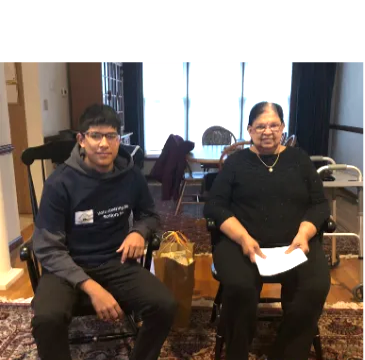
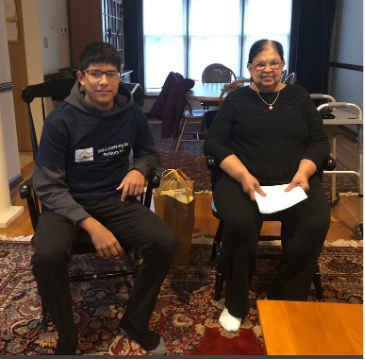
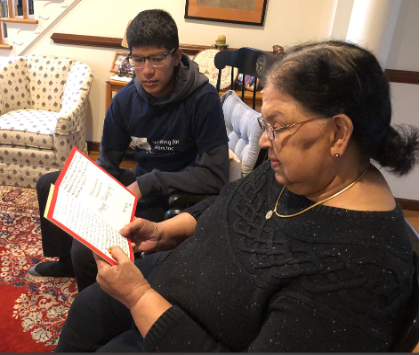
On behalf of Volunteer for Seniors (VFS) Easton, I (Neil Dutta) got the opportunity to interview Dr. Uma devi Tantravahi, one of the VFS seniors residing in Sharon Massachusetts. I met Dr. Tantravahi at her residence at Sharon, MA on 22nd November 2022. When I went to interview her on behalf of VFS, she was recovering from her knee surgery and in spite of that she agreed upon my interview request. Since I was visiting her for the first time and the day before thanksgiving, I went with card, and she really appreciated my letter. During the interview she mentioned that how VFS is supporting her in recovering from her surgery.
Briefly about Dr. Tantravahi grew up in India and she moved to United States in sixties with her husband. During our interview she mentioned to me, her struggles and challenges including sacrificing her career aspirations initially. She raised two sons (who are now established Physician) and she later received her PhD in Genetic from Columbia University around the same time when her son was also graduating from high school. After that, she served as a post-doctoral fellow and as a faculty At Childrens hospital, Harvard University. Later in 1992 joined Brown University as Professor of Pathology and retired from Brown University in 2023. During our conversation, she mentioned that she plays Veena (Indian musical instrument) and she learnt to play Veena at the age of forty-one here in Boston.
Tell us about your childhood, where you grew up, and about your family?
Dr. Tantravahi: “I grew up, in a small village called Samalkot which is in East Godavari district, Andhra Pradesh. My father was a doctor there and we were eight siblings (altogether six girls and two boys) so I grew up there. And of course, I had a lot of friends in school, etc.”
How did you meet Uncle (her husband)?
Dr. Tantravahi: “My father was a doctor for a lot of people in that town and Uncle’s father was the high school teacher and our families were friends. So, they decided that one person from this family should marry another person from the other family. Ramana Tantravahi, my future husband did his Masters Degree at Andhra University in Vizag and became a faculty there. Subsequently, after 4 years, I joined the same place to do my Masters. That is where we met and since the families knew each other, we had the blessing of the families to get married.
When did you decide to move to the United States and how different or challenging was the move. In other words, how did you adjust in a new environment?
Dr .Tantravahi: “So, before we got married, Uncle always wanted to go to United States for higher studies and so did I. My brother was already here at Harvard University doing his Ph.D. at that time and Uncle applied for Harvard and I applied for Boston University and we both got admitted. By the time I came here, I was pregnant with my first son. As typical in Indian communities, they said that “your husband’s career is more important so let him go to school first and you can do it later” So, I just obtained a small job and he went to school to study for his Ph.D. Adjusting to a new environment was pretty difficult because as a student, he did not get much money. I had my second son the following year. Even though I was working on weekends, it was difficult to manage with two young children and a husband who is very busy with his course work. But we managed and I survived. I think coming from a reasonably wealthy family and coming to USA with not enough financial means or any domestic help taught me valuable lessons in maintaining the household with a strict budget and raising my sons.”
Tell us more about your life in the United States including your typical daily schedule, profession, if you had any kids, etc.
Dr. Tantravahi: “After he graduated, we moved back to India thinking we were going to stay there. We did not get a suitable job there, so we came back to US in 1970. After two years in Massachusetts, we went to New York in 1973. He got a job at Columbia University. In 1974, when my children were in middle school and high school, I joined as a laboratory technologist in the same place where uncle was doing his job. In 1975, with my boss’s encouragement, I joined as a Ph. D student in the same department at Columbia University, College of Physicians and Surgeons. By this time, I have not sat in a classroom for 16 years. I recorded all my class lectures, came home made dinner, made sure my sons did their homework and then deciphered my lectures and prepared notes. It was a tough time but since I was determined to peruse my Ph.D. I did not mind the hard work. Finally, in 1980 I graduated and received my Ph.D, the same year my son graduated from Highschool.
The Life of a Caregiver can be very challenging especially after a certain age. However, you have continued to provide support to our loved ones – What are your day-to-day challenges as a caregiver and how do you overcome that on a day-to-day basis?
Dr. Tantravahi: “Well, I am the caregiver for my husband. Right now, he is the care giver for me because of my knee problems.
It is difficult because he cannot drive, so I am doing all the driving by taking him to all his doctor appointments, and things like that. It is difficult; however, you can manage. As long as you are able to do it.”
Do you have any support system?
Dr. Tantravahi: “Not officially, but I have a lot of friends. For example, several VFS members including Pratima and Ramakrishna help a lot. My friends and unofficial family members Bhadrinath ji and Bharati help a lot too. However, I have a lot of friends who are helping. We have a lot of friends who can help us if I need something.”
(Ms. Pratima Penumarthy and Mr. Ramakrishna Penumarthy are founder of VFS and Badarinath ji is board member of VFS).
Based on your experience as a caregiver what message do you have for seniors (like my own grandmother) who are caregivers to their partners?
Dr. Tantravahi: “It depends which country you live in. If you are in this country, it is difficult to get someone to help because it is very expensive. For elders living in India, I think they should get somebody to help them. What I can say is, do as much as you can to help them. For example, if I cannot cook, I will have somebody who can cook and brings food. So, things like that, and it all starts to manage.”
What message you have for your generation (gen Z) and what can we learn from your experiences?
Dr. Tantravahi: “From my experiences, if you really want to do something, you should try and do it. Because nothing is impossible. Even at age 60, if somebody wants to go back to school, they can.”
Do you have any special memory in life you would like to share?
Dr. Tantravahi: “My children graduating from medical schools. My older brother came here for a visit in 1998 and that happened to be my father’s 100th birthday. My father was a lover of arts and music. I learned Veena here after I came to this country. I was actually 41 years old when I started learning Veena. So, I arranged a concert in my house where I played along with my teacher and another person. That was my best memory!”
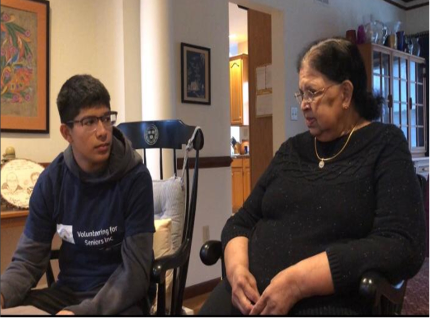
Toward the end of interview, she asked me what grade I am at high school, my career interest, and told me I can consult her during my senior years.
All in all, I am very grateful to Dr. Tantravahi to share her story and experience with me. It was a pleasure to meet with her and I hope, as she recovers from her knee surgery very, I can visit her on behalf of VSF more often and gain from her life experiences. Life and career of Dr Tantravahi inspires all of us and we can achieve our goals and dreams at any age.