
Interview Interview with Ms. Henna Chatterjee

Hello everyone, my name is Neil Dutta, a Sharon High School Student.
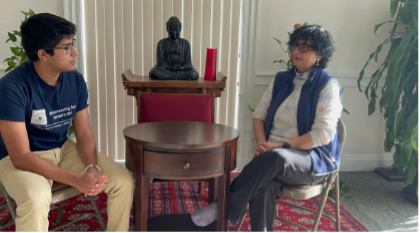
I got the opportunity to interview Ms. Henna Chatterjee on December 26th, 2025 at the Vedanta Center of Boston, on behalf of Volunteering for Seniors, VFS (based in Easton, MA).
The center was established in 1909 and serves as a spiritual and educational resource for the broader Boston community. The current resident monk is Swami Tyagananda Ji, who offers classes, worship services, spiritual guidance, and meditation.
I have known Ms. Chatterjee, since I was an infant. I refer Ms. Chatterjee as ‘Henna Maasi’ (maasi is someone equivalent of mother). Every time I meet her, she patiently teaches attendees Vedantic and spiritual values.
Compassion, respect, and service are all values Ms. Chatterjee emphasizes during her interview that can guide each of us to lead a meaningful life, through changes and challenges. Spirituality is as an integrated way of living, where work, service, and personal growth are practiced through principles of ‘Karma Yoga’ (performing our work and services with detachment—no expectation and self-awareness). She answered all of my questions with meaningful messages and offered advice for seniors that reflects the values she practices in her daily life. For me, the important takeaway from her life and spiritual journey is that challenges are opportunities for growth, and true fulfillment comes not from achievement alone but from learning, contribution, and inner clarity.
One notable thing worth mentioning (not captured during our interview Q&A) is that Ms. Chatterjee is extremely organized and a talented chef. Personally, I love her rice pudding (payesh) in every puja and she cooks amazing soups on Sundays for all of us (spiritual seekers who attend monthly Antar yoga sessions)!
1. Could you share a bit about your childhood and your family life growing up? What values or experiences from those early years stayed with you as you moved through life?
At the very beginning, Ms. Chatterjee thanks me for conducting the interview, and mentions that she has known me since childhood and is proud of the thoughtful young man I have become.
Ms. Henna Chatterjee: “I grew up in India in a family where relationships were deeply valued. Respect for elders and compassion for those less fortunate were strongly emphasized. These are values I still carry with me today, and they continue to guide many of my life choices. I cherish them deeply.
My parents taught me to be kind and loving, but also to be strong. Being strong does not mean that life is always easy or that everything goes according to plan. It means understanding that life is not only about thanking God during good times, but also learning and growing through challenges.
One of the most important lessons my parents taught me is that life is not just about personal success. It is about bringing people together and helping uplift the lives of others. That belief continues to shape how I live and serve today”.
2. You grew up in India and eventually made the United States your home. How would you describe that journey (both personally and professionally) and how did it shape who you are today?
Ms. Henna Chatterjee: “I am glad you asked that question. Growing up in India and then moving to a Western country was certainly challenging. However, the values my parents taught me stayed with me throughout that transition, and I continue to carry them to this day.
What I learned is that every challenge offers an opportunity to grow. I did not see difficulties as setbacks, but as lessons. At the same time, not everything was challenging. When I arrived in the United States, I was unfamiliar with Western culture, but friends helped guide me and taught me what it truly means to live in America.
Through that experience, I realized that core human values are the same everywhere. What changes is how we learn to navigate and express those values in different cultures. I embraced the challenges, learned from them, and grew stronger as a result. Today, I feel proud to say that I am both a good Indian and a good American.”
3. Could you tell us about your spiritual journey: where it began and how it evolved over time? Were there any family members, teachers, or friends who played a particularly influential role?
Ms. Henna Chatterjee: “My spiritual journey began within my own family, with my parents. Spirituality was a natural and important part of our daily life. My parents were very clear about balance; they emphasized the importance of education and school, but they also taught us that nurturing our spiritual life was equally essential. These lessons were introduced to us from childhood.
When I came to the United States, I was very fortunate to meet Swami Sarvagatananda Ji. Later, I met my own spiritual teacher, Swami Tyagananda Ji, who is the president of this center. His teachings deeply shaped my understanding of spirituality. He taught me that spiritual life is not separate from everyday life. It is reflected in how we think, how we act, and how we engage with the world around us.
These teachings aligned closely with the values my family had instilled in me, and together they formed a strong foundation for my life. I also feel fortunate to have learned from my fellow spiritual seekers. Through them, I learned how to conduct my life with purpose, how to serve others, and how to be an active and compassionate member of society.”
4. Even in your sixties, you maintain a full-time career while simultaneously managing much of the Vedanta Center of Boston and supporting many spiritual seekers. How do you balance your professional responsibilities with your spiritual and volunteer work, which reflects the principles of Karma Yoga?
Ms. Henna Chatterjee: “As I mentioned earlier, my spiritual teacher, Swami Tyagananda Ji, guided me at every step of my life. One important thing I have learned is that spiritual purpose never retires. It is essential to be clear about what you want and who you are. People often say, “Be yourself,” but to truly do that, you must first know yourself. Once that clarity is there, life becomes much easier to navigate.
I see spiritual life as a lifestyle, a way of thinking and living. There are no limits to spiritual growth. When you perform your duties, you are guided by the principles of Karma Yoga. Karma Yoga teaches us to do our work sincerely, without attachment. Attachment often leads to expectations, and unmet expectations lead to disappointment. When you let go of expectation, you do not break. you grow. You give your best, and in return, life teaches you valuable lessons.
Another important lesson came from my father. He always reminded me to be aware of my weaknesses. Strengths will always be there, but when you understand your weaknesses, you know where you need help. And there is nothing wrong with asking for help. We support one another. That is how life works.
I carried these same values into my professional work. I never felt that I was serving in one place and working in another. Work is work. At my job, I receive financial compensation. At the Vedanta Center and through spiritual service, I am paid in many other ways: through learning, fulfillment, and inner growth. As Swami Ji once told me, payment is not always financial. I feel I am compensated fully in both aspects of my life.”
5. Additionally, could you describe your day-to-day role and responsibilities at the Vedanta Center? How do you apply Vedantic principles in everyday life, especially during moments of stress, uncertainty, or challenge?
Ms. Henna Chatterjee: “I am glad you asked that question. My responsibilities at the Vedanta Center involve a great deal of administrative work and coordination with many people. That level of responsibility can be demanding at times. What I have learned through Vedanta is the importance of pausing. People often underestimate the power of a pause, but pausing gives you strength and clarity.
Before making decisions, whether at the Center or in my professional life, I take a moment to pause. That pause allows me to reflect on myself first, then consider what I can contribute and what others can contribute. We work together as a team. I am aware of my own weaknesses, and I recognize the strengths of others. It becomes like putting together a puzzle, where each person’s strengths complement another’s weaknesses.
Approaching work as a Karma Yogi also teaches time management. You learn to value time; not just your own, but everyone else’s as well. When you respect time, you naturally develop respect and compassion for others, recognizing that everyone is doing their best.
I also approach my role with a sense of care and responsibility, much like a mother. Motherhood is not only biological. It is rooted in compassion, guidance, and strength. A mother knows when to be firm and when to be gentle, always keeping the well-being of others in mind. That is how I try to serve: with compassion, responsibility, and inner strength.”
6. What are some of the most important lessons that life has taught you through your personal, professional, and spiritual experiences?
Ms. Henna Chatterjee: “One of the most important lessons I have learned is that change is inevitable, but growth is a choice. Change will come whether we are ready or not, but how we respond to it determines our growth.
I try to live my life not to achieve something, but to learn something. Even when I wake up in the morning, my intention is not achievement, but learning. This shift in perspective has made a profound difference in how I experience life.
One lecture by Swami Tyagananda Ji deeply changed my life. He shared a very simple yet powerful practice: remembering two things and forgetting two things. I try to live by this every day.
The two things I forget are these: First, if I do something good for someone, I forget it; so, there is no attachment or expectation. Second, if someone does something negative to me, I forget that as well. This practice of detachment creates inner freedom and allows growth.
The two things I remember are: First, everything in life is constantly changing. Nothing remains the same. Second, the only thing that truly remains is the self, which in Vedanta we call the Atman.
These principles guide how I live, learn, and grow each day.”
7. What advice would you offer to individuals, especially seniors, who are seeking purpose, clarity, or balance in their lives, particularly those who may be living alone?
Ms. Henna Chatterjee: “Living alone can actually be a blessing, but one should not live in loneliness. There is an important difference.
Seniors, including myself, carry a lifetime of experiences. Spiritual life has no retirement. Even when one lives alone, that accumulated wisdom does not disappear. Seniors have so much to offer, especially love, compassion, and understanding. If we look around us, we will see that many people need exactly those qualities.
Those who feel lonely can begin by sharing what they have learned throughout their lives. They can offer a listening ear, kindness, or guidance to anyone who needs it. When you give, you receive in return. Through service, connection naturally grows, and loneliness fades.
Living alone, when understood properly, becomes a source of strength and reflection. Once seniors recognize this, half of the battle is already won.”
8. What activities do you enjoy pursuing during your free time?
Ms. Henna Chatterjee: “I love being out and about, and I especially enjoy food. I like discovering new restaurants and trying different cuisines. I also enjoy watching movies and spending time with people with whom I can have meaningful conversations.
I am very mindful that life is a gift from God, and I try to make use of every part of it. I love to travel whenever I can, but travel does not always mean going to a different country. Even within my own city, I enjoy going for walks and exploring new places. These simple activities bring me a great deal of happiness.”
9. What message or guidance would you like to share with the next generation as they navigate an increasingly complex and fast-paced world?
Ms. Henna Chatterjee: “I will start with this: don’t make your life only about achievement. You will achieve things naturally as you go, as long as you focus on growing and contributing. Be compassionate. Be kind. And when I say be kind and loving, it has to start with yourself. When you love yourself and respect yourself, only then can you truly contribute to this world, your community, or the people you meet. If you do not have that, you cannot give anything. So, if you want to achieve something, first achieve yourself, and then contribute. When you contribute from that place, your goals will follow naturally.”
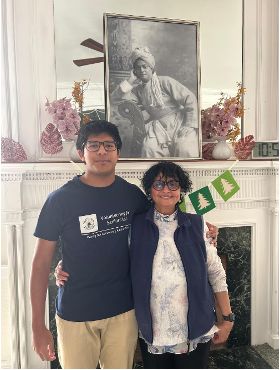
I am grateful to Ms. Chatterjee for honoring my request to interview her, and for sharing her incredible life and spiritual journey. She constantly inspires and encourages me and every spiritual seeker at Vedanta Center at Boston to perform our work & service with detachment and mindfulness!
Recorded video of our interview can be viewed through this LINK